Craft & material
From fibre
to story.
Wastra does not begin with a design on a screen. It begins with thread, water, fire, and hands that know when to stop.
Material
Materials that are not in a hurry.
We choose materials by how they age, not only by how they look when new.
Cotton
Primisima and handwoven cotton form the base of most of the collection. The texture is honest, it takes colour beautifully, and it becomes more comfortable with wear.
Silk
Silk is used for pieces that need a light drape and a soft sheen. We choose a weight that is substantial enough to be opaque and lasting.
Natural dyes
Indigo, soga, and roots produce colour that is never uniform. We do not chase uniformity—we protect character.
The process
Four stages, no shortcuts.
Choosing the fibre
Before motif, there is material. We choose threads and cloth that suit the function of the piece—not simply what is easiest to source.
Preparing the threads
For ikat, threads are bound and dyed before weaving. Bound sections stay light; exposed sections take colour. Pattern is born from resistance.
Weaving & drawing
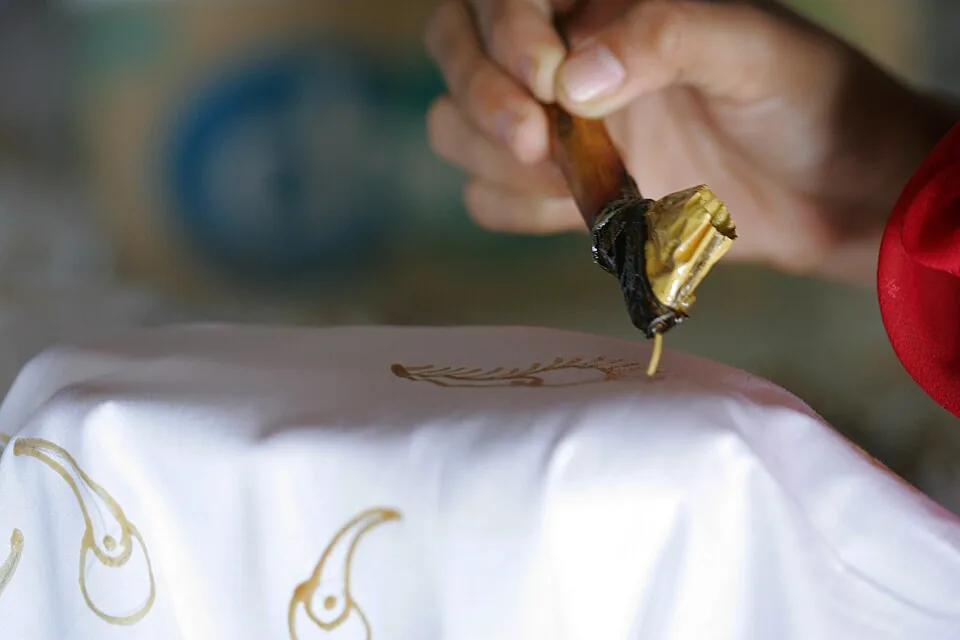
Weaving happens on traditional looms. Batik is drawn with a canting, line by line. Neither can be rushed without losing something.
Finishing
Edges are hand-finished, cloth is checked, and every variation is noted. We do not hide imperfections; we explain them.
Origins
From many places, one language.
Each region has its own technique and motifs. We do not standardise them.
Glossary
A few words worth knowing.
Batik tulis
Batik whose motifs are drawn by hand with a canting and hot wax. The process is slow and produces lines that are never entirely uniform.
Tenun ikat
A weaving technique in which threads are bound and dyed before weaving, creating motifs from the sections that resist colour.
Perada
A gold accent on cloth, often associated with ceremony and heirloom textiles. Its sheen is soft and changes with time.
Soga
A warm brown natural dye, one of the signature colours of Javanese batik, derived from bark and leaves.